






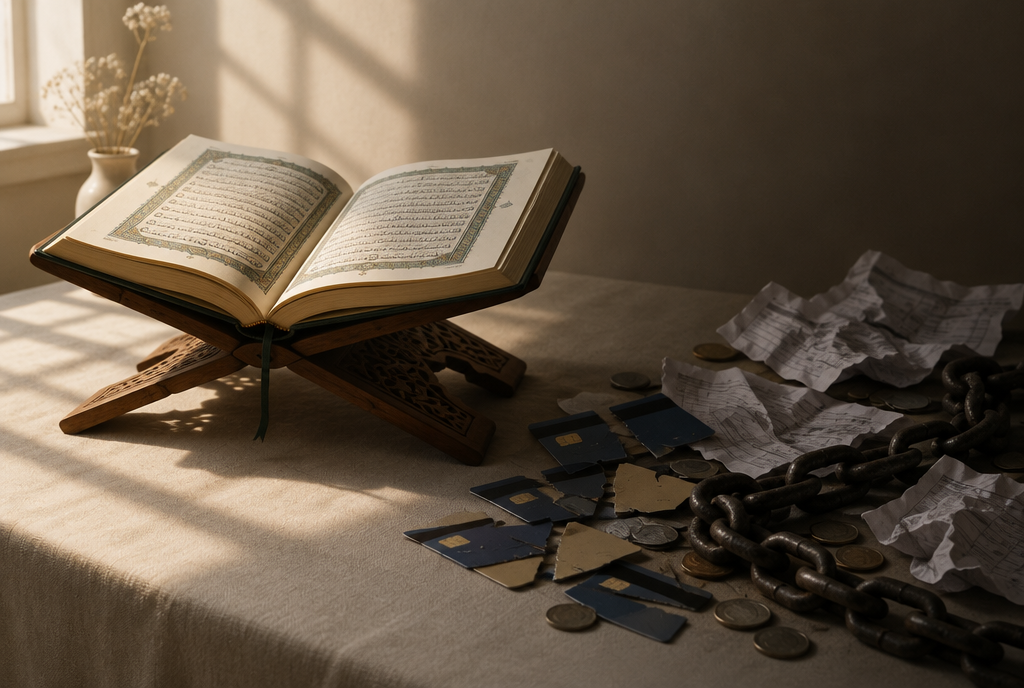
Riba (رِبًا) means any guaranteed increase charged on a loan, which today we call interest. It is one of the few sins in the Quran for which Allah declares war on those who refuse to give it up. No bank, government, social norm or fatwa can make halal what Allah has made haram.
Most Muslims know riba is haram. Yet most of us live inside it: mortgages, car loans, credit cards, savings accounts, student debt. We tell ourselves that everyone does it, that there is no other way, that a scholar somewhere said it was fine. This article asks a harder question. Why is riba haram, and why do so many of us follow people, governments and social norms instead of the Quran?
What Is Riba?
The word riba comes from an Arabic root meaning to increase or grow. In Islamic law it has two main forms:
- Riba al-nasi'ah is the increase charged for delaying repayment of a loan. You borrow 100 and must return 110. This is exactly how bank interest works.
- Riba al-fadl is an unequal exchange of the same type of goods, such as gold for more gold, which the Prophet ﷺ forbade to close every door to exploitation.
Islam does not forbid profit. It forbids profit without risk. Allah says plainly, “Allah has permitted trade and has forbidden riba.” (Quran 2:275) In trade, both sides share the risk. In riba, the lender is guaranteed his return whether the borrower succeeds, struggles or loses everything.
What the Quran Says About Riba
The Quran's language on riba is some of the most severe in the entire book.
“Those who consume riba cannot stand [on the Day of Resurrection] except as one stands who is being beaten by Satan into insanity.” (Quran 2:275)
“O you who have believed, fear Allah and give up what remains [due to you] of riba, if you should be believers. And if you do not, then be informed of a war [against you] from Allah and His Messenger.” (Quran 2:278–279)
Think about that for a moment. Allah does not declare war on those who drink alcohol or eat pork. He declares war on those who insist on riba.
He also tells us that riba does not even deliver the growth it promises: “Allah destroys riba and gives increase for charities.” (Quran 2:276) What looks like growth is, in reality, a loss of barakah.
What the Hadith Say About Interest
Jabir (may Allah be pleased with him) reported that the Messenger of Allah ﷺ cursed the one who consumes riba, the one who pays it, the one who writes it down and its two witnesses, and said, “They are all the same.” (Sahih Muslim 1598)
Notice who is included. Not only the banker who charges interest, but the person who pays it, the clerk who records it and those who witness it. Riba is not one person's sin. It is a system, and everyone who keeps it running shares in it.
The Prophet ﷺ also listed consuming riba among the seven destructive sins, alongside shirk, magic and murder. (Sahih al-Bukhari 2766)
Why Is Riba Haram?
Allah does not owe us explanations, and a believer obeys even before understanding. But the wisdom behind the prohibition is easy to see in the world around us.
- It is injustice. The lender takes no risk while the borrower carries all of it. “Do no wrong, and you will not be wronged.” (Quran 2:279)
- It transfers wealth from the poor to the rich. Those who need money most pay the most for it. Those who already have money earn more simply for having it.
- It creates money from nothing. Modern banks create most new money when they lend, and that money comes into existence already carrying interest. The whole economy is built on debt that can never be fully repaid.
- It enslaves people and nations. A family can spend thirty years paying off a home. A country can spend generations paying off loans to the IMF and World Bank, giving up its independence along the way.
- It removes barakah. Wealth built on riba may grow on paper, but Allah promises to destroy it (Quran 2:276). As Rizq & Amanah teaches, provision is a trust from Allah, and wealth gained through what He has forbidden can never carry His blessing.
How Fiat Money Has Riba Built Into It
Most people think riba is something you choose: you take a loan, or you do not. But the truth is deeper. The money in your pocket today, called fiat money, has riba built into its very nature. To understand why, we need to look at how money changed over the last century.
When money was gold
For most of history, money was gold and silver. The Muslim world traded in the gold dinar and silver dirham for over a thousand years. Later, paper notes were simply receipts. A note promised that you could walk into a bank and swap it for a fixed amount of real gold.
This mattered. A government could not create more gold out of thin air, so it could not quietly shrink the value of your savings.
1944: the world is tied to the US dollar
At the end of the Second World War, the major powers met at Bretton Woods in the United States and built a new system. Every major currency was fixed to the US dollar. The dollar was fixed to gold at $35 an ounce. Other countries were told they could always swap their dollars for American gold.
From that day, the US dollar sat at the centre of the world's money.
1971: the gold standard is broken
By the late 1960s, the United States had printed far more dollars than it had gold to back them, partly to pay for the war in Vietnam. Countries began asking for their gold back. On 15 August 1971, President Richard Nixon “temporarily” stopped anyone swapping dollars for gold.
It was never switched back on. Since that day, no major currency in the world has been backed by gold or anything real. Money became fiat, a Latin word meaning “let it be done”. Money now exists simply because a government declares it does.
1974: the petrodollar
Without gold, why would the world keep wanting dollars? The answer came through oil. In the 1970s, the United States reached an arrangement with Saudi Arabia: oil would be sold in US dollars, and the surplus dollars would be invested back into US government debt. Other oil producers followed.
Every country needs oil. So every country needs dollars. Muslim oil wealth became one of the main pillars holding up the dollar system.
Why the US dollar is the most powerful currency
Today, the dollar is the world's reserve currency. Central banks around the world hold more of their savings in dollars than in any other currency, and they use those dollar reserves to support their own money. Many currencies, including the Saudi riyal, the UAE dirham and the Qatari riyal, are fixed directly to the dollar. Most international trade, from oil to wheat, is priced in dollars.
Not every currency is officially backed by the dollar, but almost every currency in the world leans on it. That is what gives the United States its unique power:
- It can print money the whole world must use. When the US creates new dollars, part of the cost is spread across every country and every family holding them.
- It can borrow almost without limit. Because the world needs dollars, the world keeps buying US debt. Its national debt now runs into tens of trillions of dollars and keeps rising.
- It can cut countries off. Because global payments run through dollars, the US can freeze a nation's savings or block it from trade. It froze billions of dollars belonging to the people of Afghanistan in 2021, while families there faced starvation.
Every dollar is born as a debt with interest
Here is where riba enters the money itself. In the fiat system, new money is created in two main ways:
- Central banks create money by buying government bonds, which are loans to the government that pay interest.
- Commercial banks create money every time they make a loan. When a bank gives you a mortgage, it does not hand you other people's savings. It types new money into your account, and you must pay it back with interest.
So almost every dollar in existence started life as someone's debt, with interest attached from the very first moment. That is riba al-nasi'ah, built into the creation of money itself.
And there is a trap inside it. When money is lent into existence, only the loan amount is created. The interest is not. To pay the interest, someone else must borrow more money into existence, which carries more interest, which requires more borrowing. First families borrow, then businesses, then governments. The debt can never be fully repaid, because the money to repay it does not exist. The system only survives by growing its debt forever.
Printing money is theft
Every time new money is created, each existing dollar is worth a little less. This is inflation. Since 1971, the US dollar has lost more than 85% of its buying power. A family that saved honestly for decades has watched most of the value of that work quietly disappear.
And the new money does not reach everyone at the same time. Banks, governments and the wealthy receive it first, before prices rise. Ordinary workers receive it last, after the price of bread and rent has already gone up. Wealth is transferred from those who work and save to those closest to the money printer.
Allah says, “Woe to those who give less [than due], who, when they take a measure from people, take in full. But if they give by measure or by weight to them, they cause loss.” (Quran 83:1–3) In the past, cheating meant a merchant shaving a little from the scale. Today, the scale itself is cheated. Your savings are shaved from every year, and you are told this is normal.
It also breaks the rule of riba al-fadl. The Prophet ﷺ commanded that gold be exchanged for gold, like for like, equal for equal. Fiat money does the opposite. The money you save today is never equal to the money you spend tomorrow.
This is why we say fiat money is riba by its very nature. Even a Muslim who never takes a single loan still holds money born from interest-bearing debt, and still has their wealth eroded by a system that can print at will. That is why many Muslims are now looking at honest alternatives. Read Is Bitcoin Halal? to learn why Fajr Noor believes Bitcoin is a halal way out.
“But a Scholar Said It Was Allowed”
This is where many of us find our comfort. Over the years, a few voices have permitted what the Quran forbids. Some argue that modern bank interest is not real riba, only “excessive” interest is. Others have allowed conventional mortgages for Muslims in the West under the principle of necessity. And many of us simply hear “my friend's imam said it's fine” and stop asking.
Here is what we must remember:
- The overwhelming majority of scholars, past and present, agree that bank interest is riba. The International Islamic Fiqh Academy of the OIC ruled in 1985 that any increase on a loan in exchange for time is riba, including the interest charged by modern banks.
- Necessity has a real meaning. In Islamic law it refers to genuine danger to life, not the wish to own a home sooner or keep up with everyone else.
- No human being can change the law of Allah. A scholar is a guide who explains the Quran and Sunnah. He is not a lawgiver. When his opinion contradicts a clear text, the text wins.
There Is No Necessity When You Can Rent
The most common excuse for an interest-based mortgage is darurah, necessity. “I need a home for my family, so the mortgage is allowed.” It sounds reasonable. But when you look at what necessity actually means in Islam, the argument falls apart.
The principle comes from the Quran. Allah forbids carrion, blood and pork, then says, “But whoever is forced [by necessity], neither desiring [it] nor transgressing [its limit], there is no sin upon him.” (Quran 2:173) The classic example is a person in the desert who will die of hunger unless he eats what is forbidden.
From this, scholars set clear conditions before necessity can make something haram allowed:
- The danger must be real and present, such as a threat to life or health, not a future worry or a wish.
- There must be no halal alternative. If a halal option exists, there is no necessity at all.
- You may take only what removes the danger, and no more. The starving man eats enough to survive, not a feast.
- It must be temporary. It ends the moment the danger ends.
Now apply these conditions to a mortgage.
Your need is shelter, not ownership. Islam guarantees the need for a roof over your head. It does not guarantee you will own the deed to it. A family that rents has a home, a bed, a door that locks and a place to pray. The need is fully met.
Renting is a halal alternative. Renting, called ijarah, is a contract that Islam fully permits. Scholars agree on it. And because a halal option exists, the condition of “no halal alternative” fails. The moment you can rent, there is no necessity.
A mortgage goes far beyond the need. Even in true necessity, you may take only what is required to survive. A thirty-year mortgage on a house of your choosing is not the minimum needed to stay alive. It is the starving man ordering a feast.
A mortgage is not temporary. Necessity lasts only as long as the danger. A mortgage commits you to riba for twenty-five or thirty years, long after any “need” has passed.
So the real reason most people take a mortgage is not necessity. It is desire: the wish to own, to build equity, to keep up with friends and family, to not “waste money on rent”. These are understandable feelings. But a feeling is not a darurah.
Answering the common objections
- “Rent is dead money.” Rent pays for a real service: a safe place to live. Mortgage interest is the true dead money. In the early years of a typical mortgage, a large part of every repayment goes to interest, and that interest is riba that Allah has declared war on.
- “I'm just paying off my landlord's mortgage.” Your contract with your landlord is halal. If he chose riba, that is his account with Allah, not yours. “No bearer of burdens will bear the burden of another.” (Quran 6:164)
- “House prices will rise and I'll never be able to buy.” Your rizq is written. Allah says, “And whoever fears Allah, He will make for him a way out, and will provide for him from where he does not expect.” (Quran 65:2–3) Save patiently, buy with cash when you can, or look for genuine interest-free home finance.
- “Everyone in our community has one.” A majority does not make something halal. On the Day of Judgement, you will stand alone.
Even the Prophet ﷺ, the best of creation, lived in simple rooms and passed away while his armour was held as security with a Jewish man in exchange for barley he had bought on credit (Sahih al-Bukhari 2068). He used honest credit for food, never riba for luxury. If he could live this way, we can rent while we save.
Allah says of those who choose riba, “That is because they say, 'Trade is just like riba.' But Allah has permitted trade and has forbidden riba.” (Quran 2:275) In the same way, renting and a riba mortgage may look similar on the surface. But one is halal and one is war with Allah.
Do not take your scholars as lords
Allah warns about this exact mistake in the Quran: “They have taken their scholars and monks as lords besides Allah.” (Quran 9:31) When the companion Adi ibn Hatim, who had been a Christian, said, “We did not worship them,” the Prophet ﷺ explained that their scholars made halal what Allah had made haram and made haram what He had made halal, and the people followed them. That was their worship. (Jami` at-Tirmidhi 3095)
This is not about disrespecting scholars. Most of our scholars are people of great integrity, and we need them. It is about remembering that on the Day of Judgement, “the scholar said so” will not stand in place of what Allah Himself said.
Following People, Governments and Social Norms Instead of the Quran
Riba survives in Muslim lives for the same reasons many sins do. Not because people have studied the evidence and concluded it is halal, but because:
- Everyone else does it. Parents, friends and colleagues all have mortgages and credit cards, so it starts to feel normal.
- The government built the system that way. Laws, tax rules and banks are designed around interest, and it feels impossible to live outside them.
- We want the dunya now. The bigger house, the newer car, the wedding we cannot afford. Riba lets us have today what Allah may have written for us later, or not at all.
The Quran describes this pattern many times. When people are told to follow what Allah revealed, they say, “Rather, we will follow that which we found our fathers doing.” (Quran 2:170) Social norms are powerful. But a norm is not a proof, and a majority is not a source of law.
Why the Muslims Are Lost: Quran 8:73
There is a verse in Surah al-Anfal that explains our situation as an Ummah more clearly than any economist or politician ever could:
“And those who disbelieved are allies of one another. If you do not do so [i.e., ally with and support one another], there will be fitnah [oppression] on earth and great corruption.” (Quran 8:73)
Allah tells us that the disbelievers stand together and support one another. Then He gives the believers a command and a warning: you must stand with and support one another too. If you do not, the result will be fitnah on earth, oppression and trial, and fasadun kabir, great corruption.
Look at the Muslim world today and ask whether that warning has come true. Nearly two billion Muslims, and yet we watch our brothers and sisters bombed, starved and displaced while we stay silent. Muslim nations sit on enormous wealth, yet borrow at interest from the very institutions that keep them weak. We have stopped supporting one another, and instead we lean on the systems of others: their banks, their loans, their currencies and their approval.
Riba is one of the clearest examples. Instead of building our own system of fair trade, partnership and interest-free lending, the system the Prophet ﷺ and the early Muslims lived by, we adopted the riba-based system of others and called it progress. Instead of standing with one another, we stood in line at their banks. Instead of trusting Allah's promise, we trusted their credit scores.
And just as Allah warned, the result has been fitnah and great corruption. Debt enslaves Muslim families and Muslim nations. Wealth flows out of Muslim lands. Decisions about our lives are made by those who hold our debt. We are many in number, yet weak, exactly as the Prophet ﷺ foretold when he said the nations would gather against us like diners around a dish, not because we are few, but because we are like foam on the flood. (Sunan Abi Dawud 4297)
This is why the Muslims are lost and oppressed. Not because Allah abandoned us, but because we abandoned His command to stand together and live by what He revealed. “Indeed, Allah will not change the condition of a people until they change what is in themselves.” (Quran 13:11)
How to Get Out of Riba
Change begins with one person, one household, one decision at a time.
- Make sincere tawbah for past involvement, and resolve not to enter new riba contracts.
- Pay down interest-bearing debt as quickly as you can, starting with the highest interest first.
- Rent rather than take an interest-based mortgage, and save towards buying with cash or genuine interest-free finance.
- Stop using credit cards that charge interest, or pay them in full every month if you must keep one.
- Do not keep interest you receive. Many scholars advise giving any interest you have earned to charity, without intending it as your own reward.
- Look for genuine Islamic alternatives, and ask hard questions about how they work, because some products change the name without changing the substance.
- Live within your means. Contentment is a form of wealth. The home you can afford without riba is worth more than a bigger one built on war with Allah.
- Support one another. Lend to fellow Muslims without interest, invest in Muslim businesses through fair partnership, and give your zakat and sadaqah generously. This is how we obey Quran 8:73 in our daily lives.
For more practical steps, read 5 Financial Tips for Young Muslims. If you have been wondering whether alternatives like Bitcoin fit into this picture, read Is Bitcoin Halal?
Frequently Asked Questions
What is riba in Islam?
Riba is any guaranteed increase on a loan in return for time, which today is called interest. It also includes unequal exchanges of certain goods of the same kind, such as gold for more gold.
Why is riba haram?
Allah forbade riba in the Quran (2:275–279). It is unjust because the lender takes a guaranteed return while the borrower carries all the risk. It transfers wealth from the poor to the rich, traps people and nations in debt, and removes barakah from wealth.
Does fiat money have riba in it?
Yes. Since the gold standard ended in 1971, almost all money is created as debt that carries interest, either through central banks buying interest-paying government bonds or through commercial banks issuing loans. Because the interest is never created along with the loan, the system needs ever more borrowing to survive. Printing new money also erodes the value of everyone's savings, transferring wealth to those closest to the money printer.
Why is the US dollar so powerful?
The dollar became the centre of world money at Bretton Woods in 1944. After it left gold in 1971, oil began to be priced in dollars. Today it is the world's main reserve currency, many currencies are fixed to it, and most global trade uses it. This lets the United States print money the world must hold, borrow heavily and freeze other nations' savings.
Is bank interest haram?
The overwhelming majority of scholars, including the International Islamic Fiqh Academy, consider modern bank interest to be riba and therefore haram, whether you pay it or receive it.
Is a mortgage haram in Islam?
A conventional interest-based mortgage involves riba, so it is haram. Some have allowed it under necessity, but necessity in Islam only applies when there is a real danger and no halal alternative. Renting is a halal alternative that meets the need for shelter, so there is no necessity for a riba mortgage.
Can I take a mortgage out of necessity?
No. Necessity (darurah) requires a real danger, no halal alternative, taking only the minimum needed and a temporary situation. Your need is shelter, and renting fully meets it. Wanting to own a home is a desire, not a necessity.
What is the punishment for riba in Islam?
Allah declares war on those who refuse to give up riba (Quran 2:279) and describes them rising on the Day of Resurrection like someone driven mad by Satan (Quran 2:275). The Prophet ﷺ cursed everyone involved in it and listed it among the seven destructive sins.
What does Quran 8:73 mean?
Quran 8:73 says the disbelievers are allies of one another, and that if the believers do not also stand with and support one another, there will be fitnah and great corruption on earth. It is a warning that the Ummah becomes weak and oppressed when Muslims abandon one another.
Is it riba if I only receive interest and do not pay it?
Yes. The Prophet ﷺ cursed both the one who consumes riba and the one who pays it. Receiving interest is consuming riba.
Read More in Rizq & Amanah
Every dollar you hold is rizq from Allah and an amanah you will be asked about. Rizq & Amanah by s.hukr explains provision, trust in Allah and the responsibility that comes with wealth, in simple, practical language. You can also read our guides What Is Rizq? and What Is Amanah?
Ready to read it? Get your copy of Rizq & Amanah by s.hukr at Fajr Noor, or browse the full set of s.hukr books.


Leave a comment
All comments are moderated before being published.
This site is protected by hCaptcha and the hCaptcha Privacy Policy and Terms of Service apply.